Friday, January 3, 2014

And Baobob's Your Uncle

The ubiquitous, mighty baobab tree. Which is not a tree, but rather a fibrous plant that looks like a tree, much like bamboo is actually a grass. Though the wood is useless, the leaves and fruits are used as medicinal foods, mixed in with couscous or ground to a powder both for flavoring and also to help fight both diarrhea and diabetes.
 
 
We see them almost wherever we go, and I can't help but snap photos even as we're driving through the countryside.
 
 
Once they get old enough (a few hundred years old), they get hollow inside, and traditionally were used as burial sites, like the tree below, whose opening is fenced off to respect the remains, though this human skull has worked its way out to the entrance.


Here, south of Saly, we visit what is supposedly the largest baobab in Senegal and Western Africa. I don't know; I haven't checked them all. This one has been scientifically documented as over 800 years old, so basically, it was a sapling when Notre Dame was being built in medieval France. The only way in is through a very small hole and some serious contortions, and once you're in, you need to step to the side to avoid having bat guano dropped on your head.


One of Gigi and Pippa's favorite and most memorable parts of the entire trip is hanging out with these kids outside the great baobab.
 

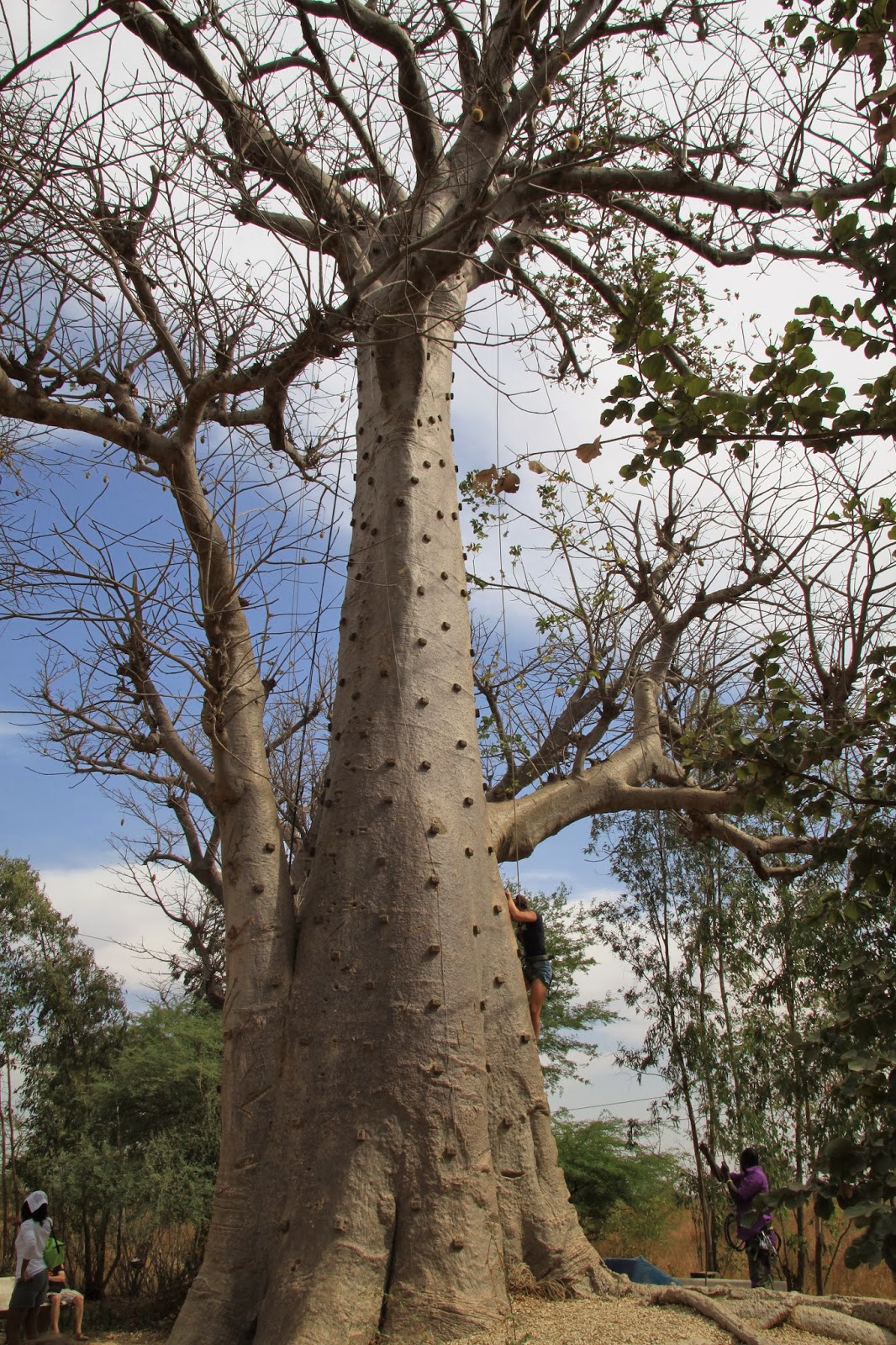
It's not just climbing in them, though. It turns out, they're fun to climb on, too. Some brilliant mind has created the "Accro-Baobab" -- just like the "accrobranche" ropes courses throughout France, but in this case, in the baobabs. Don't worry, Mom: Anthony, who used to lay ropes courses when he was at university as a summer job, is impressed with the safety.


And it turns out climbing up them is also fun. But scary. And a little challenging. The girls both manage it, all the way to the tippy-top.

   

I'm glad that Anthony's given his safety stamp of approval, because the super-high, super-long Tyrolienne (as these long zip lines are called) is also super-scary. Once I'm zipping down, I'm completely relaxed and having fun, but that moment of making myself jump off the high platform is a little nerve-wracking, in a kind of bungee-jumping way.


All Creatures Great and Small

I fully recognize that a "real" safari takes days and dedication and usually a trip to Eastern Africa. But we are not above the "fake" safari available to us in Senegal, at the Réserve de Bandia, near Saly. It is, frankly, a nice way to do a safari while in Western Africa with children: At 35sq km (compared to South Africa's Kruger National Park, which is 7,580sq km, or 217x the size), it provides a big reward for little effort and patience. Many of its star animals are imported from other areas of Africa in order to protect and nurture endangered species, and all the animals are vegetarians (except for a specific few in enclosures), so that they won't kill each other in the small space.

The ostriches:


Adorable. But what about this demonic look?


I'm guessing that ostriches have some sort of double eyelid system, and that I've caught him mid-blink. We have a private safari jeep, and as the ostriches walk right up to us, our driver pulls away quickly, and I urge, "No, no! Go back! I was getting such good photos!" At which point, the guide tells me that the ostrich was about to peck out my camera lens. At which point I understand why we need to have a jeep and a guide in the first place.

The white rhinos:
 
 
Sometimes with their friends the phacochères (warthogs). And a beautiful bird. Possibly a long-tailed glossy starling. Possibly not. I'm not exactly a skilled bird-watcher or identifier.
 
 
The star attractions -- to us anyway -- the giraffes:
 

Here, serving as the backdrop for a beautiful blue bird called an Abyssinian Roller (Coracias abyssinicus -- and isn't it amazing what I can figure out using the internet?!) :

 
The beautiful roan antelopes:

 
South African impalas: 
 

And some of the park's "also-rans": the alligators, monkeys, turtles.


And outside of the park, here are the also-also-rans of Senegalese creatures: mosquitos and bacteria.
 
Whether it's the garbage, the pollution, or some tropical flowers, one drawback to this trip is that Pippa seems allergic to the whole country. Really, deeply, strongly allergic. And she's reacting to the mosquito bites so strongly, she starts sleeping in socks on both her hands and feet so that not only can the mosquitos not get in, but also she can't scratch herself too badly. Her nose is red from the runny nose and constant blowing. Poor little cookie, but at least she seems healthier for the last half of the trip than the first half.


Thankfully, Hotel Les Flamboyants, which is the place we stay the longest at the end of our trip, has good mosquito netting. The girls and I sleep in the queen, and Anthony takes the twin by himself. Don't feel bad for Anthony. He's happy to be excluded from the itching, sneezing, nose-blowing, all-night-squirming-and-snuggling bed.
 

And as for bacteria, we make it through the entire trip to Senegal with no food poisoning and nothing more than a slight nod to Delhi Belly, aka Montezuma's Revenge. Near the end of the trip, Anthony is faced with lettuce on his plate and, in a moment of desperation, he cracks and actually eats it, with absolutely no adverse affects. We're supposed to like all creatures great and small, but in this case, we're pretty happy to avoid the small.
 

Thursday, January 2, 2014

A Little More Remote

After the fish market, we head further away from "civilization" into the bush.
 
 
Our main goal for the morning is the Siné-Saloum Delta, where we take a boat ride through the mangroves.
 
 
While the bird life isn't as impressive as at Djoudj, it's still what would be considered great bird watching anywhere else.
 

Plus, it's tranquil and lovely. Though I like to see and do everything that can be seen and done, even I will admit that sometimes on vacation it's nice to feel relaxed and just enjoy the surroundings. In this case, it's nice for us city-folk to be out of Paris and in the middle of nature. The girls even get to drive the boat.


For lunch, our guide takes us to "La Saint-Louisienne," which makes sense since he's from Saint Louis. We have barracuda yassa (marinated, grilled, served with rice and stewed onions), and I have to say that this little dive, which uses the back yard dirt floor as its kitchen space, produces the most delicious fish I eat the entire Senegal trip. And the shrimp isn't bad, either. And no food poisoning.


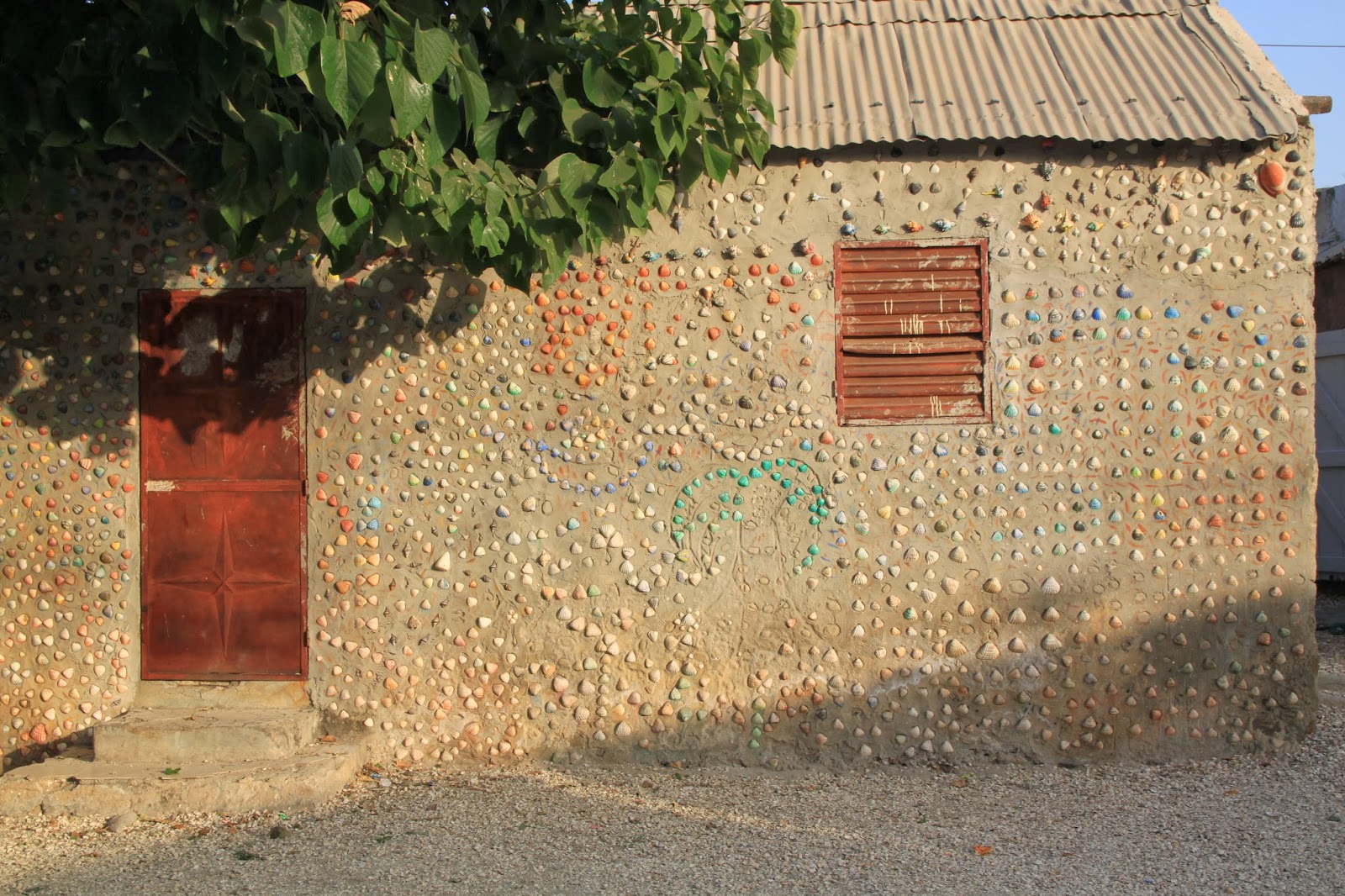
After lunch, which takes an incredibly long time (I guess dirt floor kitchens aren't super-efficient), we head to the Jaol-Fadiouth area, which is more commonly called Shell Island. At first, we wonder why.
 
 
Then it starts to become clear.


The prettiest site is the Mixed Muslim and Christian Cemetery which is a bridge apart from the residential zone. The whole area is very tolerant, the guide explains to us, with many mixed marriages. It's one of the few areas of Senegal where the ratio is not 95% Muslim, 5% Christian, but something more like the reverse. We are told that in families with mixed marriages, the girls will generally adopt their mother's religion, and the boys, their father's.


It's the Christian part of the cemetery that's open to visitors. One of the inhabitants made it to 104 years old!
 
 
It's not just that there are lots of shells on the island, the island itself is basically made of shells. At the summit of the hill, it's about 9m deep (that's almost 30 feet) of shells. It's very crunchy walking.


In the end, it's not the most amazing day of the trip, but it's pleasant, and we see some new things, and I'm not complaining. Interestingly, though, it turns out it is also one of the most expensive days of the trip. But one of the ways I bargain the price down is by promising our great guide Ismaïla Sow (who speaks really excellent Italian, Spanish, French, and decent English) that I would publish his contact info to people who might be interested in arranging a trip. So, true to my word, if you're going to Senegal -- and especially the north near Saint Louis -- and need some reliable, honest, high quality tour-guiding, contact him at sowguia@hotmail.com or 77-275-58-66.